
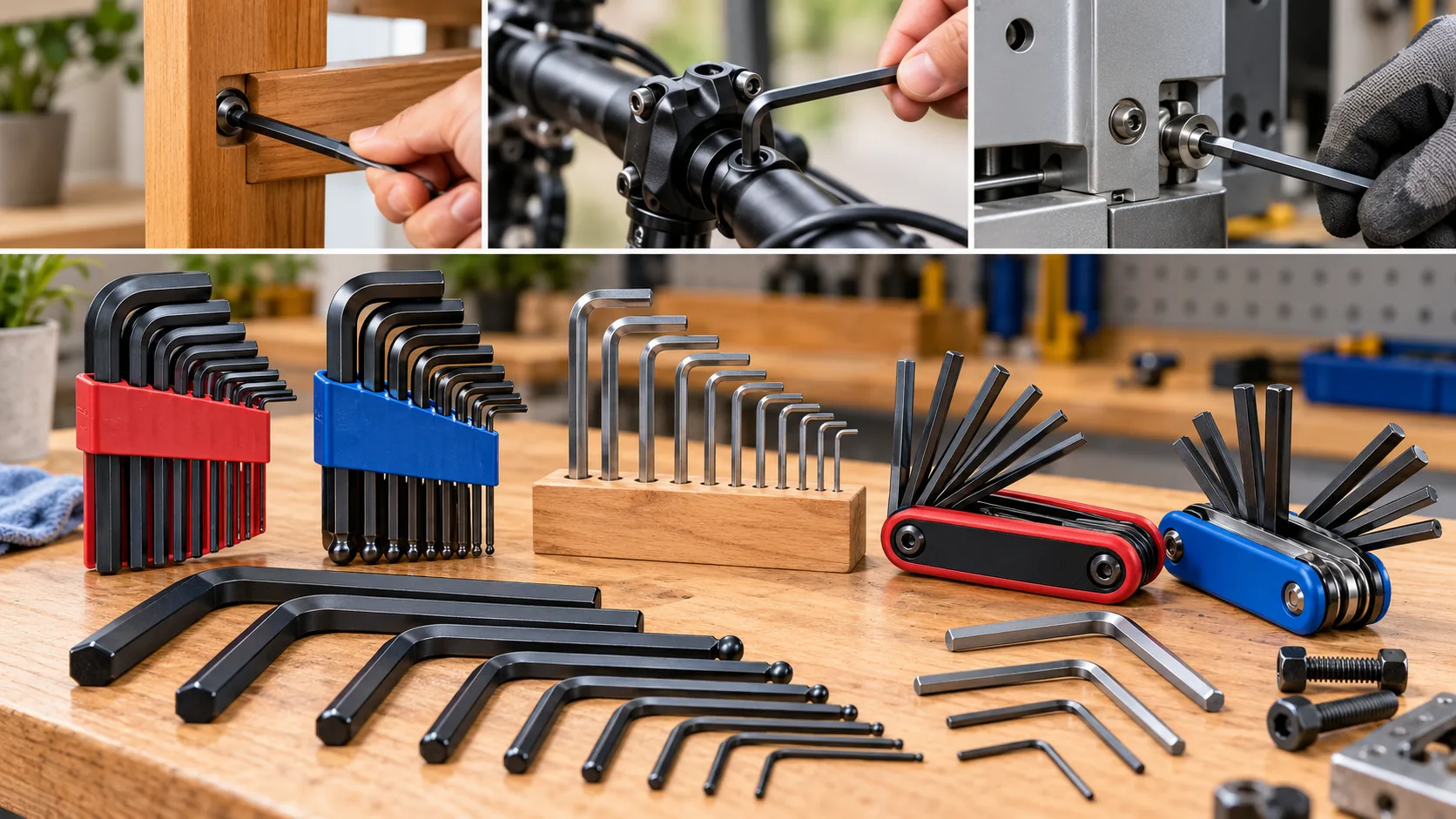
An Allen wrench set is one of the most useful hand tools for assembling furniture, repairing household items, and maintaining mechanical equipment. These compact tools are designed to tighten or loosen screws and bolts with hexagonal sockets. Whether you are a homeowner, DIY enthusiast, mechanic, or professional technician, having the correct Allen wrench sizes can make everyday repair and maintenance tasks easier.
Allen wrenches, also called hex keys, come in different shapes, sizes, and materials to suit specific applications. Some sets include standard L-shaped keys, while others feature T-handles, ball ends, or folding designs. Understanding the differences between metric and SAE Allen wrench sizes is especially important because using an incorrectly sized tool can damage fasteners.
Choosing the right Allen wrench set involves considering durability, comfort, accessibility, and the types of projects you regularly complete. A quality set can support furniture assembly, bicycle maintenance, automotive repairs, and various household applications. This guide explains Allen wrench types, common sizes, practical uses, and important factors to consider before selecting a set.
What Is an Allen Wrench Set?
An Allen wrench set is a collection of hexagonal tools designed to fit screws and bolts with internal hex-shaped sockets. These tools are commonly known as hex keys, Allen keys, or hex wrenches. Their distinctive six-sided design allows users to apply turning force to compatible fasteners without using traditional screwdrivers or external bolt sockets.
Most Allen wrench sets contain multiple sizes arranged in a holder, case, or folding organizer. Each wrench fits a particular hex socket dimension, allowing users to select the correct tool for different fasteners. Sets may include metric measurements, imperial measurements, or both systems, depending on the intended applications and manufacturer specifications.
Allen wrenches are widely used because they are compact, versatile, and relatively simple to operate. Their narrow shape makes them useful for accessing recessed fasteners and working in limited spaces. However, proper size selection is essential because loose-fitting tools can round out screw sockets and make future repairs more difficult.
Different Types of Allen Wrenches
Allen wrenches are available in several designs, with each type offering advantages for particular tasks. Standard L-shaped hex keys remain popular because they are compact, affordable, and suitable for general maintenance. Other designs focus on comfort, improved reach, or easier handling during repetitive assembly and repair work.
T-handle Allen wrenches feature a horizontal grip that can improve control and make repeated turning more comfortable. Folding Allen wrench sets keep several hex keys together in one compact handle, making them convenient for storage and transportation. Ball-end hex keys provide additional access when a fastener cannot be approached directly from above.
Some manufacturers also offer long-arm, short-arm, and screwdriver-style hex tools. Long-arm designs provide additional reach, while short-arm versions can be useful in confined areas. Choosing among these options depends on the working environment, available clearance, and amount of turning force required for the task.
Standard L-Shaped Allen Wrenches
L-shaped Allen wrenches are among the most recognizable and commonly used hex tools. Their simple design includes a long arm and a shorter arm connected at a right angle. This arrangement provides two practical working positions, allowing the user to choose between additional reach and a different grip configuration.
The long arm can help reach recessed fasteners, while the short arm may provide more leverage when the longer section is used as a handle. This flexibility makes L-shaped Allen keys suitable for furniture assembly, household repairs, and general mechanical maintenance. Their compact construction also makes them easy to store in toolboxes or workshop drawers.
Standard L-shaped sets are often available in both metric and SAE sizes. Many include protective holders with clearly marked dimensions to simplify tool selection. For homeowners building a basic repair toolkit, an organized set of quality L-shaped hex keys is often a practical starting point.
T-Handle Allen Wrenches
T-handle Allen wrenches feature a grip shaped like the letter T, creating a comfortable handle for turning hex fasteners. This design can reduce hand discomfort during repetitive assembly tasks and offers convenient control. Mechanics, technicians, and workshop users often prefer T-handle hex keys when regularly working with compatible screws and bolts.
The handle allows users to rotate the tool comfortably while maintaining alignment with the fastener. Some T-handle models include additional hex tips built into the handle, providing different working positions. These tools can be particularly useful for equipment maintenance, workshop projects, and repeated assembly tasks involving similar fastener sizes.
However, T-handle wrenches require more storage space than traditional L-shaped sets. Their larger handles may also be inconvenient in tight locations where surrounding components limit movement. Homeowners should consider the available working space and expected frequency of use before choosing a complete T-handle Allen wrench set.
Ball-End Allen Wrenches
Ball-end Allen wrenches have a rounded, hexagonal tip designed to engage compatible fasteners from a slight angle. This feature can improve accessibility when a screw is difficult to approach directly. Ball-end designs are especially useful for furniture hardware, mechanical assemblies, and equipment with limited clearance around recessed fasteners.
The rounded tip allows users to position the wrench at an angle rather than requiring perfect alignment with the screw socket. This can make starting or removing lightly tightened fasteners more convenient. However, ball ends generally provide less contact area than straight hex tips and are not suitable for applying high torque.
When dealing with stubborn or tightly secured screws, a properly fitting straight-end hex key is usually more appropriate. Applying excessive force through a ball end can damage either the tool or the fastener. Many long-arm Allen wrench sets include a ball end on one side and a standard hex tip on the other.
Folding Allen Wrench Sets
Folding Allen wrench sets combine multiple hex keys inside a compact handle, similar to a folding pocket tool. This design keeps different sizes together and reduces the likelihood of misplacing individual wrenches. Folding sets are popular among bicycle owners, homeowners, and people who prefer portable tools for occasional adjustments.
Most folding hex key sets include several commonly used sizes that rotate outward from the handle. Their compact construction makes them convenient for tool bags, drawers, and travel repair kits. Because all keys remain attached, users can switch between sizes without searching through a separate collection of loose tools.
The main limitation of folding sets is their larger handle, which can interfere with access to recessed or restricted fasteners. They may also provide less flexibility than individual L-shaped keys for certain applications. Nevertheless, a well-made folding Allen wrench set offers convenient organization for routine household and equipment maintenance.
Metric Allen Wrench Sizes Explained
Metric Allen wrench sizes are measured in millimeters and are commonly used in furniture assembly, bicycles, appliances, and modern mechanical equipment. Common sizes include 1.5 mm, 2 mm, 2.5 mm, 3 mm, 4 mm, 5 mm, 6 mm, 8 mm, and 10 mm. Larger or more specialized sizes are also available for industrial applications.
Smaller metric hex keys are generally associated with compact screws and lightweight equipment, while larger sizes are used for heavier fastening applications. However, the correct wrench size always depends on the fastener’s socket dimension rather than the overall size of the equipment. Manufacturers typically specify the required dimensions in their product documentation.
A comprehensive metric Allen wrench set helps users handle a wider variety of projects without relying on incorrectly sized tools. Clear size markings are particularly helpful because smaller hex keys can appear similar. Selecting the exact size improves contact with the fastener and reduces the possibility of stripping its internal socket.
SAE Allen Wrench Sizes Explained
SAE Allen wrench sizes use fractional-inch measurements rather than millimeters. These tools are commonly found in certain American-made machinery, older equipment, and products designed around imperial fastener standards. Typical sizes include 1/16 inch, 5/64 inch, 3/32 inch, 1/8 inch, 5/32 inch, 3/16 inch, and 1/4 inch.
Although some SAE and metric sizes are close, they are not necessarily interchangeable. A slightly undersized wrench may appear to fit a fastener but can slip when turning force is applied. This creates a risk of damaging the hex socket, particularly with small screws or fasteners that have already experienced wear.
Homeowners who regularly maintain different equipment may benefit from owning both metric and SAE Allen wrench sets. Separate, clearly labeled holders make identifying the correct measurement system easier. Keeping both types available can also reduce frustration when assembly instructions do not clearly identify whether a fastener uses imperial or metric dimensions.
Allen Wrench Size Chart: Metric and SAE
Understanding standard Allen wrench sizes makes it easier to select suitable tools for specific applications. Metric hex keys are measured in millimeters, while SAE keys are identified using fractions of an inch. The table below provides examples of common sizes and general applications, although actual fastener requirements vary between products.
| Metric Size | SAE Size | Common Applications |
|---|---|---|
| 1.5 mm | 1/16 inch | Small equipment and precision hardware |
| 2 mm | 5/64 inch | Small accessories and adjustable components |
| 2.5 mm | 3/32 inch | Compact hardware and furniture fittings |
| 3 mm | 1/8 inch | Furniture and light mechanical assemblies |
| 4 mm | 5/32 inch | Bicycle accessories and household equipment |
| 5 mm | 3/16 inch | Furniture and general mechanical fasteners |
| 6 mm | 1/4 inch | Larger bicycle and equipment components |
| 8 mm | 5/16 inch | Heavier mechanical assemblies |
| 10 mm | 3/8 inch | Larger equipment and machinery |
The metric and SAE entries shown in each row are approximate size comparisons, not exact equivalents. For example, a 5 mm hex key is slightly larger than a 3/16-inch key. Using one in place of the other may damage the fastener, so it is important to match the original specifications.
When purchasing an Allen wrench set, check whether it includes the sizes required by your equipment. Some compact sets omit less common dimensions, while larger collections provide broader coverage. A clearly organized set with durable markings can make size identification easier and help prevent mistakes during everyday repair projects.
Common Uses of Allen Wrench Sets
Allen wrench sets are widely used for assembling flat-pack furniture, including desks, chairs, tables, cabinets, and bed frames. Many furniture manufacturers use hex socket screws because they provide a compact fastening solution. An appropriately sized Allen key allows users to handle assembly hardware without needing a large collection of specialized tools.
Bicycle maintenance is another common application for hex keys. Many bicycle components, including accessories, seat adjustments, and certain handlebar fittings, use internal hex fasteners. However, specific components may have manufacturer-defined torque requirements, making correct tool selection and appropriate professional guidance important for safety-critical adjustments.
Allen wrenches are also used in automotive maintenance, household appliances, workshop equipment, and various mechanical products. Their compact shape makes them convenient for working around recessed screws and limited access points. Whether completing simple furniture adjustments or maintaining equipment, using the correct hex key helps protect fasteners and supports reliable results.
How to Choose the Best Allen Wrench Set
Choosing the right Allen wrench set begins with identifying the types of projects you regularly perform. Homeowners assembling furniture may only need a basic metric set, while workshop users may prefer both metric and SAE collections. Understanding the required sizes helps prevent unnecessary purchases and ensures the tools are compatible with common fasteners.
Material quality is another important consideration because Allen wrenches experience twisting forces during normal use. Many quality sets are manufactured from hardened alloy steels designed to resist wear and deformation. Chrome vanadium and other suitable tool steels are common options, although manufacturing quality and proper heat treatment also affect performance.
Comfort, storage, and accessibility should also influence your decision. Clearly labeled holders simplify organization, while ball-end and long-arm designs provide additional flexibility for certain tasks. Selecting tools based on practical requirements rather than appearance alone can help you build a dependable collection for household maintenance and DIY projects.
How to Use an Allen Wrench Without Damaging Screws
Proper Allen wrench use begins with selecting a tool that fits the fastener securely. The hex tip should match the screw socket without noticeable looseness or excessive movement. A poorly fitting wrench can slip, round the socket edges, and make the fastener difficult to remove or tighten during future maintenance.
Keeping the wrench properly aligned with the fastener is also important for reliable operation. Tilting a standard hex tip unnecessarily can reduce contact between the tool and screw. Ball-end wrenches provide some angular access, but they should not be used for high-torque applications where full engagement is needed.
Avoid using excessive force when a screw does not move normally. Resistance may indicate corrosion, damaged threads, incorrect sizing, or another mechanical problem requiring further assessment. For equipment with manufacturer-defined torque specifications, appropriate tools and instructions should be followed to prevent damage or unsafe assembly conditions.
Allen Wrench Set Materials and Durability
The durability of an Allen wrench set depends heavily on the steel used in manufacturing and the quality of its construction. Common materials include chrome vanadium steel, chrome molybdenum steel, and other hardened alloys. These materials can offer useful strength and wear resistance when properly manufactured for hand-tool applications.
Surface treatments may provide additional protection against corrosion and everyday wear. Black oxide finishes are common on traditional hex keys, while some manufacturers use chrome plating or specialized protective coatings. The effectiveness of these finishes depends on their quality and the environment where the tools are stored and used.
Even high-quality hex keys can become worn or damaged through repeated use, incorrect sizing, or excessive force. Rounded tips, visible twisting, cracks, and damaged edges indicate that a tool may no longer engage fasteners reliably. Replacing worn wrenches helps reduce the likelihood of damaged screws and poor tool performance.
How to Maintain and Store Allen Wrenches
Proper maintenance can extend the useful life of an Allen wrench set and help keep the tools ready for everyday tasks. After use, removing dirt, moisture, and debris can reduce corrosion and preserve the condition of the working tips. A soft cloth is usually sufficient for routine cleaning of most standard hex keys.
Storing Allen wrenches in their original holder or a designated tool organizer makes size identification easier. Organized storage also prevents individual keys from becoming lost among other workshop tools. Keeping tools in a dry environment can help reduce rust, particularly when they are stored in garages or utility spaces exposed to moisture.
Inspecting the tips occasionally is another useful maintenance habit. Worn or rounded edges can reduce contact with fasteners and increase the risk of slipping during use. A well-maintained Allen wrench set supports more dependable performance and makes household assembly and maintenance tasks easier to manage.
Common Mistakes to Avoid When Using Allen Wrenches
One of the most common mistakes is confusing metric and SAE Allen wrench sizes. Because certain dimensions appear nearly identical, users may select a tool that fits loosely inside the fastener. This mistake can damage screw sockets and create unnecessary difficulties when adjusting or removing the affected hardware.
Another mistake is applying excessive force through an unsuitable wrench design. Ball-end tools, small hex keys, and compact folding sets have different practical limitations depending on their construction. Using extension pipes or improvised leverage can also overload a tool and create a risk of sudden slipping or breakage.
Poor storage and maintenance can create additional problems over time. Missing sizes, corroded tips, and damaged tools may encourage users to substitute unsuitable alternatives. Maintaining an organized collection and replacing worn components can help prevent common fastening problems while supporting safe, reliable tool use.
Conclusion
An Allen wrench set is a versatile addition to any household toolbox because it supports furniture assembly, mechanical maintenance, and numerous everyday repair tasks. Understanding the differences between L-shaped, T-handle, ball-end, and folding hex keys makes selecting appropriate tools easier. Each design provides advantages depending on accessibility, comfort, and the type of fastener being used.
Choosing the correct Allen wrench sizes is equally important for protecting screws and maintaining reliable tool performance. Metric and SAE hex keys may appear similar, but their dimensions are not always interchangeable. Selecting durable materials, properly fitting tools, and convenient storage options can improve the overall usefulness of a wrench collection.
Whether you are building furniture, maintaining bicycles, or working on household equipment, a quality Allen wrench set can make common tasks more manageable. Proper tool selection, careful handling, and regular maintenance help reduce unnecessary wear and fastener damage. With the right collection, homeowners and DIY enthusiasts can handle a wide variety of everyday projects more confidently.
Frequently Asked Questions (FAQs)
What Is an Allen Wrench Set Used For?
An Allen wrench set is used to tighten and loosen screws with hexagonal sockets. Common applications include furniture assembly, bicycle maintenance, household repairs, automotive components, and various mechanical equipment.
What Are the Most Common Allen Wrench Sizes?
Common metric sizes include 1.5 mm, 2 mm, 2.5 mm, 3 mm, 4 mm, 5 mm, 6 mm, and 8 mm. SAE sets commonly include fractional-inch sizes such as 1/8, 5/32, and 3/16 inch.
Are Allen Wrenches and Hex Keys the Same?
Yes, Allen wrenches and hex keys refer to the same general type of tool. Both feature hexagonal tips designed to engage screws and bolts with matching internal hex sockets.
What Is the Difference Between Metric and SAE Allen Wrenches?
Metric Allen wrenches use millimeter measurements, while SAE versions use fractional-inch measurements. Their sizes may appear similar, but they are not always interchangeable and should match the fastener specifications.
Which Type of Allen Wrench Set Is Best for Home Use?
A quality L-shaped metric and SAE Allen wrench collection is a versatile choice for many household tasks. Ball-end options or folding sets can provide additional convenience depending on available space and applications.